Showing posts with label Cloud Computing. Show all posts

Sunday, 30 December 2012

The Economics of Cloud Computing

To be competitive in today's tough economy climate, IT organizations need to find ways of delivering innovative business services while taking cost out of their operations. IT costs are normally categorized as operating expense and capital expense, and effective cost containment requires the right balance between the two.

To reduce capital expense, many IT organizations have turned to virtualization, the ability to pool and share IT resources. Pooling resources reduces capital expense of hardware, software and facilities. Less infrastructure, and correspondingly, less energy is required to deliver the same quality of service. 


Standardization on a common software stack, common operational policies, service delivery and management processes, is considered one of the most effective ways of reducing operating expense. With standardization and automation, less human resources and skill is required to deliver the same quality of service. Expertise is generally recognized as one of the fastest growing piece of the IT spend.  

Addressing standardization and virtualization is key to reducing infrastructure costs, while meeting the dynamic needs of the business. With increased infrastructure standardization, organisations are able to achieve greater economies of operating expense. Similarly, IT organizations that leverage virtualization within their infrastructure realize greater economies of capital expenditure.  

Leading IT vendors have been ceasing on this opportunity to support a closer alignment of IT to the business. IBM's Expert Integrated Systems were motivated by the increasing need for IT organisations to achieve cost optimization. 

They are built on industry standards and designed to enable organizations to accelerate cloud adoption. Cloud computing enables business agility, making it possible for organizations to improve service delivery by applying engineering discipline and economies of scale in an Internet inspired architecture. Expert Integrated Systems can be deployed in a customer controlled private network to drive efficiency, while retaining control and customization in a private cloud model.

Sunday, 16 December 2012

What is driving the increasing adoption of Cloud Computing ?


The challenges associated with growing IT complexity and its impact on business agility has been the focus of recent conversations on this blog. There is clearly a need to address increasing operating costs associated with the delivery of IT services. Studies conducted by IBM, IDC and others has shown that over the last few years, management and administration costs have increased significantly against flat or decreasing new system spend, and marginal increases in power and cooling costs.

Cloud computing is the new consumption and deliver model inspired by consumer Internet services.  Underpinning cloud computing are proven capabilities of virtualization, automation and standardization, which is driving IT simplification and increased efficiency. Line of business executives are attracted to the self-service characteristics of Cloud, the new sourcing options it presents, and its economy of scale. Cloud essentially represents the industrialization of delivery for IT supported services. Leading cloud vendors like IBM provide clients with the flexibility to adopt the cloud solution appropriate for their organization, be it a Private Cloud, Public Cloud or a Hybrid Cloud including elements of both. In a recent newsletter, IDC predicted the increasing emergence of workload specific Clouds in 2013.

I see organizations adopting Cloud in 3 steps

1) Consolidation
2) Virtualization
3) Automation

Consolidation reduces server sprawl and results in a reduction in infrastructure complexity. Reduced complexity translates to less effort to operate and manage, which should improve operational costs and reduced total cost of ownership

By adopting a shared, virtualized infrastructure, IT organizations are able to significantly increase hardware utilization, resulting not only in a reduction in new hardware spend, but also with regards to associated costs like cooling and power. A virtualized infrastructure can also simplify application deployment and ongoing operation by removing physical resource boundaries.

Add automation to a consolidated and virtualized infrastructure, and you can dramatically reduce deployment cycles. Standardized delivery of IT services provides an opportunity to introduce granular metering and billing. This enables the flexible delivery of new processes and services.

IBM's PureApplication System is designed to accelerate cloud adoption. It enables customers to deploy Cloud services in less than 4 hours, from power on and connection to the client's network. It is integrated in the factory with advanced virtualization that enables IT resources to be shared among many applications. This results in more efficient utilization of IT resources and reduced hardware costs through economies of scale.

Patterns of Expertise, the ability to embed application configuration, deployment and lifecycle management best practices significantly reduces IT cycle times and management costs by enabling applications to be deployed with minimal skill in the shortest time possible.

Workload optimization algorithms and tight integration of all components, including software and hardware, results in a platform that can scale up and down to optimize IT resource utilization, with the network and storage system optimized to the workload.

Thursday, 13 December 2012

What's IDC's prediction for 2013?

IDC recently published their 2013 predictions, with Mobile, Social, Cloud and Big Data platforms expected to  drive 90% growth in the IT market between 2013 and 2020. I summarized the key 2013 trends are as follows:
  • IT spending will exceed $2.1 trillion, driven by the adoption of smart mobile devices
  • IT spending in the growth markets will represent 34% of worldwide spend, and 50% of all new growth in the IT marketplace
  • Package applications providers like IBM, Microsoft and Oracle will become major Software as a Service (SaaS) providers
  • There will be an explosion in Platform as a Service (PaaS) offerings tailored for specific industry applications
  • Converged systems will transition from hype to market reality, as enterprise datacenter and cloud-provider use cases converge
  • Line of Business executives will drive the increasing adoption of industry solutions, with 60% of all new IT spend influenced by LOB executives
  • Enterprises will transition from Social Network experimentation to integration
  • Big Data investments investments will continue to grow, with a shift of focus to analytics and discovery tools, and analytic applications


The promise of Cloud enabled Analytics

The promise of analytics is all too familiar. The ability to optimize traffic flow in realtime, conduct fraud and risk detection as transactions are taking place, understand and act on customer sentiments in social networks among many others. Analytics has truly evolved from a business initiative to a business imperative.

In IBM's 2011 CIO study, a majority of CIOs ranked Analytics as the #1 factor contributing to an organization's competitiveness. A 2011 study conducted by IBM Institute of Business Value and MIT  Sloan Management Review confirmed that organizations that embraced analytics were 2x as likely to outperform their peers.

Recently, we have witnessed a shift of focus from Enterprise Data Analytics to Big Data Analytics. This is being accelerated by the significant amount of data being generated daily; 12 terabytes of tweets, 5 million trade events every second, thousands of video feeds from surveillance cameras etc. A quote from John Naisbitt summarizes the state of today's economy very well...“We have for the first time an economy based on a key resource [Information] that is not only renewable, but self-generating. Running out of it is not a problem, but drowning in it is.”

In this new economy, there is a need for complementary approaches to Analytics to handle these new  sources of data. Traditional sources of enterprise data, which are usually structured and logical can be handled quite effectively by Transactional, ERP and Data Warehouse Systems. Emerging Sources of unstructured data, e.g. machine generated data like RFID, log data and data from sensors, or Cloud Data which is typically includes a combination of text, multimedia and other forms of unstructured data, require a platform tuned to their unique workload characteristics. There is therefore a need to develop capabilities that bridge the need for Analytics on structured and unstructured data.

The emergence of these trends has shifted IT into the center of business, but IT faces challenges realizing the value Analytics can deliver. Due to the increasing complexities of IT infrastructure, most organizations are unable to shift budgets away from maintaining and operating existing systems. The increasing data volumes, formats and sources of data is driving the need for new solutions that minimize complexity and reduce time to value.

Cloud computing can minimize these barriers and reduce complexity through standardized service delivery. Clouds computing platform optimize investments through a shared infrastructure with elastic scalability to handle variable workloads. This results in a faster time to value. 


IBM's PureData System accelerates cloud adoption. PureData System is optimized for very high transactional throughput and high speed peta scale analytic and transactional data workloads. IBM clients are using PureData System for Database & Analytics workload consolidation on a highly scalable and resilient infrastructure.

Tuesday, 11 December 2012

A look at IBM's Enterprise Service Bus (ESB) Solutions


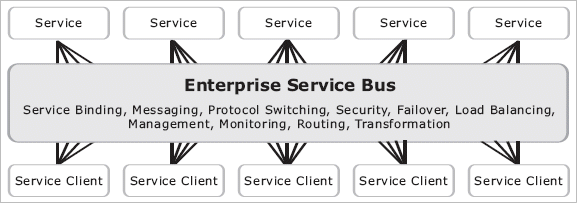
There are two primary functions an ESB performs
  1. Messaging, the reliable delivery of information where and when it is needed
  2. The augmentation of messages with routing information, data mediation and the distribution of business events, commonly referred to as "Service Enrichment"
ESBs deliver business flexibility and service virtualization by enabling a clear separation between applications which run the business. The ESB delivers an infrastructure for connecting the applications and services together, making it possible for business services and solutions to be modified with minimal impact.  

IBM has 3 different ESB flavors

WebSphereEnterprise Service Bus

WebSphereMessage Broker
WebSphereDataPowerIntegration Appliance

Customers with an investment in WebSphere technologies like WebSphere Application server, WebSphere Portal or WebSphere BPM can leverage WebSphere ESB with their existing skill set, resulting in lower cost and faster time-to-value.


On the other hand, those whose primary challenge is integrating a wide range of non-standard applications into the standards based infrastructures, as well as those who already have an investment in WebSphere MQ will value the flexibility and depth of capability provided by WebSphere Message Broker.

And for those who value the simplified experience of an appliance form factor with easy administration and configuration, and require security at the message level, network level, and device level, the DataPower Integration Appliance delivers all this out of the box.

Monday, 10 December 2012

Why PureSystems ?


In a previous blog post, I presented my views on one of the key motivation behind IBM's introduction of PureSystems into the marketplace, citing the need for IT to adopt solutions that are optimized to achieve the business agility needed in today's business environments. Most c-level executives anticipate significant change and complexity ahead, with only a handful prepared to handle it. With complexity on the rise, agility becomes a key competitive advantage.

In the past, IT used to be the control point. The lines of business specified their requirements and IT designed and implemented what they needed.  The line of business had their own application silos, with IT providing safely through separate ownership and segregation of resources. Increasingly, the line of business teams are making the call, with business owners having greater control.  In the cloud space, evidence of this trend can be confirmed by the increasing adoption of Software as a Service applications.  Without IT consulation, the business is reaching out to external IT services providers to fulfill their requirements.  In one fell swoop, the entire IT organization can be cut out, and to make it worse, the IT organization is left to deal with subsequent integration problems.  And clients are demanding more too.  The rise of mobile computing puts pressure on IT organizations to deliver support for new types of applications, additional capabilities that enterprise applications never had to deal with before.  

This need for agility is transforming the relationship between IT and the business in very profound ways. The true promise of IBM's PureSystems isn’t just about addressing the complexity of IT,  it is about redefining the economics of IT.  Over half of the business executives believe that cloud computing enables business transformation; leaner, faster, and more agile processes.  This is strategic thinking.  Organizations that approach cloud in a tactical fashion risk adding complexity and inefficiency due to fragmentation, redundancy and operating silos. PureSystems is designed to accelerate cloud adoption, enabling organizations that embrace cloud strategically, from a business as well as IT perspective, to capture new business value through innovation, flexibility, and speed, with integrity and security, while reducing cost and complexity. 

What is Cloud Computing?

Cloud Computing - NIST* Definition (*National Institute of Standards and Technology)

Cloud computing is a model for enabling convenient, on-demand network access to a shared pool of configurable computing resources (e.g., networks, servers, storage, applications, and services) that can be rapidly provisioned and released with minimal management effort or service provider interaction.
but ….. this is a
technology centric definition. From a Business Point of View....

Cloud computing is a model for enabling cost effective business outcomes through the use of shared application and computing services.  The value …. if possible …. is better economics in the execution of business processes.

Sunday, 9 December 2012

The new bread of IT practitioners...

In 2012, a majority of CEOs interviewed during an IBM funded CEO Study identified technology as having the greatest impact on their business. Technology had always featured highly, but this is the first time it was ranked #1.

What does this mean for the IT profession?

You can argue that in future, there will be a need for IT practitioners to focus on enabling business users to consume and control business content for competitive advantage, through a reasoned application of information technology. This requires an IT practitioners to be a
  •  Consensus builder
  •  Results oriented
  •  Generalist
  •  A technology expert
  •  Not just a top level software designer
  •  Not (just) a programmer
  •  Not the project manager
  •  Not a product expert
  •  Not a lone scientist
Against this backdrop of increasing expectations and reliance on IT by the business, IT is not being provided with the resources it needs to implement new capability. On average, IT budgets are growing at less than 0.8% per year, resulting in most spend being applied to maintaining on going operations and support of existing IT infrastructures. This is a reflection of the complexity of today's IT systems, and the need for significant resources to keep the running.

Most c-level executives and technical leaders I have interacted with recently, mostly across Europe, have cited integration and collaboration between IT and Lines of Business as critical success factors for innovative projects. As the CEO study shows, innovation is increasingly delivered through software, applications and technology.

In April 2012, IBM introduced a new bread of Expert Integrated Systems.

Given that solutions are manifested as architectures, Expert Integrated Systems are integrated in the factory to include systems, applications and process components optimized for specific workloads. PureSystems integrates a broad variety of products, technologies and services, various systems and applications architectures, and diverse hardware and software components into a ready to use system. By taking complexity out of enterprise IT systems,  IT practitioners are able to dedicate more of their time to creating strategic business outcomes, aligning business needs with appropriate Solutions and technologies.

This is how I see the professional evolving over time, with IT practitioners collaborating across lines of business and IT to align with strategic business planning, solution design and delivery; leveraging ready to use workload optimized Expert Integrated Systems that accelerate time to value.

What can you expect from a Smart Stadium?


As home entertainment systems improve (e.g. 3D HD TV), stadiums are coming under increased pressure to differentiate themselves and offer a pleasing entertainment environment for their fans and visitors. 

To continue to attract visitors, there is a need to address the challenges of managing traffic flows,  parking, the need for collaboration with public safety officials (police, fire, ambulance) etc.

The most progressive stadiums are investing in technology that can be used to improve the operation of their facilities, essentially enabling them to create a Smarter Stadium.


The ability to monitoring gate throughput can result in a better understanding of how fast the stadium is filling, enabling operations staff to optimize the flow of traffic into and out of the stadium, as well as within the grounds. Data from the turnstiles can be aggregated into a dashboard and analyzed against key performance indicators. Operators can use dashboards to view the flow rate across each gate, and if the traffic becomes too high, they can take corrective action by either slowing the flow further downstream, or diverting traffic to other gates with more capacity. As fans drive into the stadium, they could be notified by SMS to park at an alternative location to optimize traffic flow into the stadium.

Performance of concession stands can also be monitored to understand how each is performing. Monitoring sales channels and offers performance should give a good insight into POS revenue and concourse level revenue, making it possible for decisions to be taken in realtime to improve sales performance on the fly. Data could be aggregated further into concession location revenue and terminal revenue to analyze and understand buying behavior and trends across different parts of the stadium. Sales transaction information could also be combined with other queue monitoring systems to offer realtime navigation assistance to stalls with the shortest queues, or ensuring stalls do not run out of items in popular demand.

Another interesting use case could be related to compliance. Let's assume that alcohol sales are not allowed past the 4th quarter of a football game. Sales data from the POS terminals could be aggregated and the transactions validated against business rules. When an alcohol sale violation incident occurs, an alert is triggered and relevant information could be displayed on the stadium operations consoles and stadium maps, and passed onto an Incident Management system where a notification could be sent to other systems and devices, e.g. to alert staff with mobile devices. All data generated can be stored in a data warehousing system for subsequent analysis and reporting. 

The capabilities and use cases described in this article can be implemented on IBM's PureApplication System, a system designed to reduce IT complexity and accelerate time to value.  It  ships with all storage, networking and compute capabilities integrated into a rack in the factory, and pre-configured and optimized for Web Application and Database workloads. Patterns are used to capture best practice and accelerate the deployment and lifecycle management of pre-integrated, optimized industry solutions like the one described in this article.

Visit the IBM Smarter Stadium Solution for more information 


Wednesday, 5 December 2012

PureData for Analytics Value Proposition

The PureData for Analytics offering, a member of the PureSystems family of Expert Integrated Systems offers a simple-to-use approach for serious Analytics on structured data.

Analytics activities such as data exploration, discovery, transformation, model building and scoring can be performed where the data resides, in the warehouse.

This reduces the time it takes to build and deploy Analytics models, accelerating fact-based decision based on insightful Analytics.

Practitioners can also experiment iteratively with different models, operationalizing and making advanced Analytics more accessible.

What's a Field Programmable Gateway Array?

While conducting a deep dive into IBM's PureData for Analytics system, it became obvious that Field Programmable Gateway Array played a key part in its performance. Little did I know that this technology is used in many every day electronic devices, e.g. DVDs make use of it to facilitate reads of high quality compressed digital data off spinning discs without jitters.

The device itself is a semi conductor chip equipped with a large number of internal programmable gates. When programmed, it acts as a specialized hardware for specialized tasks requiring high performance.

In PureData for Analytics, data is delivered from disk to memory as quickly as it can be streamed off disk, compressed and cached in memory by the FPGA using a smart algorithm which ensure that frequently used data is served out of memory. The embedded engines in the FPGA can be dynamically modified and extended programmatically, and act on streaming data at extremely high speed. In addition to compressing the data using semiconductor based technology, the FPGA filters out unnecessary columns and rows to boost performance.

My first "in depth" look at the PureData for Analytics System


Hosts
The primary interface to the PureData for Analytics system are high performance Linux hosts. External tools and applications, e.g. reporting, backup and recovery etc, interact with the host via standardized interfaces, e.g. JDBC etc. The host compiles SQL queries into executable code snippets, creates optimized query plans and distributes the snippets to massive parallel processing nodes for execution. The host is in an active-passive high availability cluster configuration, mirroring data to the standby hosts which monitors the primary host and takes over in case of a failure.

S-blades
The bulk of the analytics workload processing occurs on intelligent massively parallel processing nodes called S-blades. S-blades are optimzed for processing analytics workloads at massive scale. They contain multi-core CPU, multiengine Field-Programmable Gate Architectures, and gigabytes of RAM, all optimized to work together to deliver peak performance. Continuous availability is made possible my the systems management software, which monitors the s-blades (including memory), and automatically takes a failed S-blade out of service and moves the processing load to a spare one.

Disks
The S-blades are connected to disk enclosures via a high-speed interconnect that enables streaming of data to the S-blade memory at the fastest rate possible. The disk enclosures contain high density, high performance disks. Redundancy is built into the data path from each S-blade to the disks. Each drive is mirrored in a RAID 1 configuration, and should a disk fail, the storage subsystem simply redirects I/O processing to the mirror without interruption of service. Spare drives are included, allowing the system to replace failed drives and regenerate content for full redundancy.

Network
The communication in the MPP grid occurs on an optimized IP based network designed for high volume data warehousing traffic patterns. It allows maximum utilization of the network bandwidth without overloading it, thereby allowing predictable performance close to the data transmission speed of the network. There are 2 completely independent networks for redundancy. The data network is also completely separate from the management network. This enables the system to assess the health of its components even where there might be data network problems.

Tuesday, 4 December 2012

Optimizing Database Warehousing Operations

The biggest challenge or bottleneck across date warehousing operations is the speed at which the database engine can read from and write to disk. This is commonly known as disk I/O bottleneck.

Most efficient analytics platforms minimize data movement, and are able to process streaming data from disk to memory in parallel, and on a massive scale. In the case of IBM's Netezza, this is accomplished by using innovative hardware acceleration. It uses Field Programmable Gate Arrays (FPGA) to filter extraneous data as early in the stream and as fast as the data can be streamed off disk.

By eliminating data that is not required close to the data source, downstream components like CPU, memory and network do not have to deal superfluous data, significantly reducing I/O bottlenecks and improving system performance.

Sunday, 2 December 2012

Expert Integrated System Design

Expert Integrated Systems are a new breed of IT systems that ship pre integrated in the factory with processing, storage and networking components for faster time to value.

They are born optimized for a specific workload and built to deliver industry leading price-performance ratio with appliance simplicity.

The challenge for IT providers is to create a system that combines the best components, (rather than the most advanced or most highly performing), to create a design where the component s work together to deliver the best price -performance. In other words, an elegant design to overcome common IT operational challenges.

Sunday, 25 November 2012

Data Warehouse in a Big Data World. What is the use case?

I like the analogy in the IBM Big Data Platform book titled "Harness the Power of Big Data".

It tells the story of the days long gone, when miners could easily spot nuggets or veins of gold with the naked eye. This made investing easier, as its value could be seen and therefore the resources required to extract it considered against its perceived value. Using a Big Data analogy, we can consider this gold to be "high value-per-byte of data".

Assume for a moment that there is more gold nearby, but it is just no visible to the naked eye. Trying to find this gold is a bit more of a gamble and potentially more expensive. This would be "low value-per-byte of data" due to the challenges associated with finding gold not visible to the naked eye.

With the right equipment however, it might be possible to economically process lots of dirt and keep the flakes of gold found. This flakes can be taken for processing and combined to make flakes of gold.

Back to our Big Data analogy...

In this scenario, it would make sense to keep all the dirt we could find (in a Big Data System), so that as new, economical dirt processing techniques emerge (Big Data Analytics on commodity systems) we would have an opportunity to extract the flakes of gold (value / insights) and store it for processing into gold bars (in our Data Warehousing system).

Hadoop is a Big Data batch system that allows users to store all data in its native business object format and get value out of it through massive parallel processing on commodity components.

Data Warehouse is characterized by "speed-of-thought response times" requirements where sustainable data with  proven value stored and delivered interactively.

It is therefore clear to see that in a Big Data world, there is value and a place for both Hadoop (Big Data) and Data Warehouse systems.

IBM's Hadoop system is Infosphere Big Insights. For simplified Big Data Analytics, look no further than IBM PureData for Analytics powered by Netezza, and Infosphere Warehouse for your Data Warehousing needs.

TerraEchos..."the next generation big-data analytics company"

I came across TerraEchos recently, an IBM business partner with a set of capabilities that illustrates the potential Big Data Analytics provides.

TerraEchos describe themselves as a company that extract meaningful information from massive amounts of complex streaming data on the fly, and simultaneously deliver insights, decisions and actions on the fly - at the precise moment they are needed. This in my view is the promise of Big Data Analytics.


As you can see from the diagram to the right, their Streaming Analytics capability requires significantly less time to analyze data.

Some of the Big Data Analytics capabilities the  TerraEcho platform exhibits includes the ability to analyze data irrespective of the amount, speed, or source of digital data, including input from any kind of cyber or physical sensor, in both structured and unstructured form. It is being positioned as suitable for organization that requires the processing, analysis, and visualization of multiple or complex streaming data sources.

One use case that caught my attention was a sophisticated sound classification system that can be used for real-time perimeter security control.  Thousands of sensors buried underground can be used to collect and classify sounds. The system can differentiate between a whisper of the wind and a human voice, or the sound of a human footstep from a running deer. If can even identify or affirm sounds that are difficult for humans to pick up.

TerraEcho has partnered with IBM to deliver these capabilities. IBM's PureData platform has been designed to simplify systems for delivering data services, making the deployment and analysis of Big Data more accessible. 

What are some of the trends creating opportunities for Big Data enriched analytics?

As I seek to understand Big Data and what it means to me as an IT practitioner, and to my clients as a consultant, I have found it useful to identify some of the trends that have underpin this opportunity
  1. The number of RFID tags used in supply chain, tracking conference attendees, tracking luggage at airports, monitoring temperature of food, structures etc has increased from about 1.3 billion in 2005 to over 30 billion by end of 2011. Prices are predicted to drop below 1US cent making it possible to instrument event more systems.
  2. A flight from London to New York generates about 650 TB of data which could be proactively analyzed to gain new insights that could lead to improvements in safety and other efficiencies.
  3. Capturing every user's online clickstream would generate TBs of data that can be used to analyze and optimize the shopping experience. 
  4. Data generated from smart meters can be used to better understand customer behavour, align supply better to demand, and enable customers to make more informed decisions about their energy usage patterns.
  5. Take Facebook. The ability to analyze the whole data population, taking into account intents and sentiments can offer tremendous value. Doing this is not without its challenges. Facebook for example, experiences over 2.5 billion likes and more than 300 million photo uploads each day.
  6. ..and Twitter. Twitter's 140 character or less design allows users to provide precise commentaries on a variety of subjects. The value to be derived from analyzing this data for sentiments and intents is significant.
  7. What about location based services (LBS)? Apparently, the average commuter in London has their photo taken about 150 times as they travel to work. Most of the mobile devices we carry with us have LBS enabled. This information can be used to further personalize interactions. 
So, there is a lot of data being generated, and this will increase over time. Most of the data is not analyzed at all. Imagine being able to not only analyze data at rest, but also data in motion, as it hits the enterprise. He in lies the tremendous opportunities of Big Data Analytics. The PureData System from IBM simplified today's data requirements and enables clients to develop capabilities that enable them to gain insights that create a competitive advantage.