Showing posts with label Smarter Cities. Show all posts

Friday, 4 January 2013

What IT systems does a Smart City need?

A McKinsey Global Institute article "Urban world: Cities and the rise of the consuming class", reflects on the speed and unprecedented scale of city expansion. This is placing an increasing demand for new environmentally friendly infrastructure for water and energy, buildings, transportation and communication. Migration is motivated mostly by the search for a better life, and in additional to the infrastructure challenges previously outlined, this also places a strain on the cities to deliver citizen based services such as education, health, public safety, economic development and social programs.

Smarter city operations rely on the ability to capture data that can be used to anticipate and proactively resolve problems. Problem resolution can be achieved by coordinating processes and resources for more efficient operations. Take public safety as an example. IT systems can be deployed to predict, monitor and mitigate crisis situations. This can be achieved by automatically analyzing video streams for threats based on known criminal patterns. Similar capabilities can be applied to transportation for more effective traffic management, and for analyzing water use and consumption patterns, thereby enabling utilities to identify leakages and optimize repair jobs for improved service delivery.
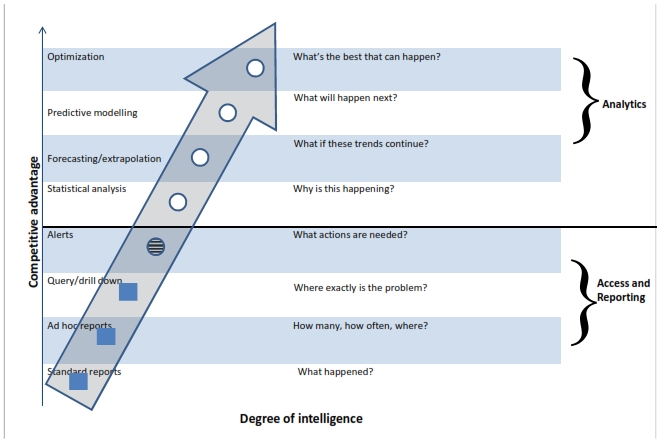

The figure to the left is from  "Competing on Analytics, Davenport and Harris, 2007". 

To be competitive, Smart Cities need to deploy Analytics capabilities that enable the delivery of a high quality of services that meets and exceeds citizen expectations today, and  can accommodate future needs for real-time dynamic access to innovative new services. 

Additionally, these new services need to be resilient, secure, compliant with local requirements, and sufficiently agile to address new risks posed by an ever more connected and collaborative world. And all of this needs to be achieved cost effectively. IBM's PureData System for Analytics is designed specifically for this use case.

Imagine a situation where city operations can be collaboratively managed via Executive, City Operations and Agency dashboards that include domain key performance indicators for standard operating procedures. Such a system could support centralized planning, execution and monitoring for more efficient operations.  

IBM's Intelligent Operations Center delivered on a Cloud enabled PureSystems platform, enables cities to not only contain operational cost and complexity, but achieve breakthrough productivity gains through rapid time to value via virtualization, optimization, energy stewardship.


Monday, 17 December 2012

Explaining how IBM is making the cities work better...


I was at home last night watching CNBC (could have been Bloomberg) with my 10 year old daughter when an IBM advertisement campaign came on and got her excited. Needless to say I was left with the task of explaining what IBM does today. What's the IBM company of 2013? What capability would encapsulate what "Building a Smarter Planet" signifies?

As I pondered through this, I settled on the view that the best way of approaching the issues is to focus on a challenge most of us experience / encounter on a daily basis. The need to leverage technology to sustain economic growth and enhance the quality of life of citizens in a rapidly changing world appeared to be a good choice.

From an offerings point of view, I narrowed my focus on IBM's Intelligent Operations Center portfolio. Our city leaders are being held to account, and need to improve their decision making. IT can help by enabling them to derive insights from the information and data they have at their disposal. In this instance, the volume of data needs to be sufficiently comprehensive and readily available for analysis. Additionally, where historical data is not available, IT can also be used to anticipate problems, so the right people can get in front of events and problems before they become a crisis. And all of these activities require coordination; coordination of people, resources, systems etc.
 

The need to empower city leaders, from mayors to the police chiefs, heads of transportation, and beyond is clear. The Intelligent Operations Center Portfolio of services enables users to

    1.    Leverage available information to make better decisions
    2.    Analyze problems and resolving them proactively
    3.    Coordinate resources and processes to operate effectively

The initial 3 areas of focus was the intelligent management of operations, whatever they might be, traffic and water
management.

Intelligent Operations Management is about planning, organizing, monitoring and sharing information between various stakeholders. We are in an era where governments are being held to account, so the ability for public sector executives to access information on dashboards that include domain specific key performance indicators is critical. 


With respect to traffic management, the need for realtime visibility is a obvious. The ability to analyze historical data and correlate to traffic incidents can enhance future planning. Water is one of the world's most precious resources, and in many parts of the world needs to be managed carefully. IBM has invested in developing capabilities that enable utility companies to instrument, collect, analyze and visualize data on water usage using Geographical information systems. IBM is also innovating on the delivery of these capabilities to its clients, offering both the ability to deploy this on premise, in which case the PureApplication System would be a attractive platform, or as a Software as a Service offering on IBM's Smart Cloud.

Sunday, 9 December 2012

What can you expect from a Smart Stadium?


As home entertainment systems improve (e.g. 3D HD TV), stadiums are coming under increased pressure to differentiate themselves and offer a pleasing entertainment environment for their fans and visitors. 

To continue to attract visitors, there is a need to address the challenges of managing traffic flows,  parking, the need for collaboration with public safety officials (police, fire, ambulance) etc.

The most progressive stadiums are investing in technology that can be used to improve the operation of their facilities, essentially enabling them to create a Smarter Stadium.


The ability to monitoring gate throughput can result in a better understanding of how fast the stadium is filling, enabling operations staff to optimize the flow of traffic into and out of the stadium, as well as within the grounds. Data from the turnstiles can be aggregated into a dashboard and analyzed against key performance indicators. Operators can use dashboards to view the flow rate across each gate, and if the traffic becomes too high, they can take corrective action by either slowing the flow further downstream, or diverting traffic to other gates with more capacity. As fans drive into the stadium, they could be notified by SMS to park at an alternative location to optimize traffic flow into the stadium.

Performance of concession stands can also be monitored to understand how each is performing. Monitoring sales channels and offers performance should give a good insight into POS revenue and concourse level revenue, making it possible for decisions to be taken in realtime to improve sales performance on the fly. Data could be aggregated further into concession location revenue and terminal revenue to analyze and understand buying behavior and trends across different parts of the stadium. Sales transaction information could also be combined with other queue monitoring systems to offer realtime navigation assistance to stalls with the shortest queues, or ensuring stalls do not run out of items in popular demand.

Another interesting use case could be related to compliance. Let's assume that alcohol sales are not allowed past the 4th quarter of a football game. Sales data from the POS terminals could be aggregated and the transactions validated against business rules. When an alcohol sale violation incident occurs, an alert is triggered and relevant information could be displayed on the stadium operations consoles and stadium maps, and passed onto an Incident Management system where a notification could be sent to other systems and devices, e.g. to alert staff with mobile devices. All data generated can be stored in a data warehousing system for subsequent analysis and reporting. 

The capabilities and use cases described in this article can be implemented on IBM's PureApplication System, a system designed to reduce IT complexity and accelerate time to value.  It  ships with all storage, networking and compute capabilities integrated into a rack in the factory, and pre-configured and optimized for Web Application and Database workloads. Patterns are used to capture best practice and accelerate the deployment and lifecycle management of pre-integrated, optimized industry solutions like the one described in this article.

Visit the IBM Smarter Stadium Solution for more information