Showing posts with label Social Business. Show all posts

Thursday, 20 December 2012

Part 3 Social Business : Building learning visions

In the face of an increasingly globally competitive business landscape, organisations will have to deal with huge uncertainties related to their viability and sustainability and many will face a range of demographic changes over the next few decades, including mergers and acquisition, ageing workforce, the transience and mobility of the workforce, as well as a whole range of other economic and societal developments that are likely to impinge significantly on the types of skills and competencies required in the future.

In order to respond to such uncertainty and serve the changing needs and diversity within the workforce, learning spaces cannot be rigid or exclusive. They need to build on, interconnect and integrate informal and formal provision that already exists. Designing new learning spaces requires companies to consider not only the purpose of acquiring knowledge now, but far more importantly, the changes necessary for a better, more holistic learning environment for their workforce in the future. They need to start, then, by asking not ‘what tools do we want?’ but instead ‘what sort of learning environment do we want to see in future?’ They need to ask not ‘what sorts of learning relationships do they want to foster? What competencies do they want learners to develop? What tools and resources are available to support learning?’

Several dynamics need to be taken into account when considering alternative models of learning. Immediate contextual dimensions, such as cross organisational partnerships, wider cultural influences, as well as establishing clarity about critical learning factors, such as the role of the learner, the organisation and pedagogy. Until organisations ask these questions, they will not be designing learning spaces for the future, but will simply be reproducing technologies of the past, albeit with more innovative capabilities.

For learning to be effective, a strategy defining the sort of learning interactions and practices is desired. Organisations need a ‘built andragogy strategy’, the collaboration and human resource management vision to underpin the design principles for the workplace of the future.

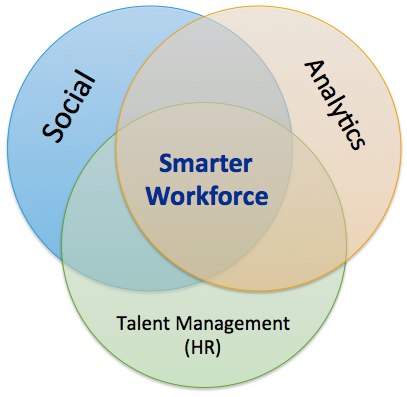
To learn more about becoming a creating a smarter workforce, click this link

Part 2 Social Business : What might new learning networks look like


In this second series, we take a look at what new learning networks might look like. What might the organisational landscape of the future look like? What types of trainers, spaces and places for learning will be available? Where, and with whom, should learning happen?

If organisations are interested in achieving a fully personalised learning environment designed around the needs, interests and aspirations of learners, they need to challenge a number of fundamental assumptions which have historically underpinned the learning landscape:
  • First, they need to challenge the assumption that expertise and knowledge reside only within the Human Resources department, and to ask instead, what might be gained from tapping into the resources that exist in the wider employee community and within the networks that employees are already connected to.
  • Second, they need to challenge the assumption that ‘learning’ and ‘training’ are different words for the same thing, and to ask instead what different approaches to and models of learning exists the workplace and the wider Internet community?
  • Third, they need to challenge the assumption that a one-size-fits-all approach is most effective, and examine how the recognition of learners’ diverse voices and experiences can enhance inclusion, aspiration and achievement through the creation of personalised learning trajectories.
  • Finally, as digital resources increasingly offer opportunities for networked, collaborative and distributed learning and interaction, they need to challenge the assumption that the easiest and most cost effective approach to organising learning is within the walls of their organisation.
Organisations need to move away from the institutionalised logic of the human resources department as factory, to the network logic of the learning community. Indeed, they need to move towards a notion of extending learning, whereby human resources department rethink the possibilities around what can be learnt, where learning can happen and who is involved in the learning process. Rather than continuing to build systems based upon centralised control of the human resources organisations and a predefined curriculum, organisations need to move to systems organised through more porous and flexible learning networks that link communities of interests and multiple spaces and places of learning. Social Business tools can empower your employees to form communities and share knowledge

Tuesday, 18 December 2012

Part 1 Social Business : Why learning networks?


In this 3 part series, I revisit an article I wrote in March 2008 outlining the significance of networks within the context of learning.

Social, technical and leisure life is increasingly organised around networks. The metaphor (and reality) of the network has come to be seen as epitomising the social, economic and technological changes of the last 30 years. The network is now the fundamental underpinning structure of social organisation – and that it is in and through networks – both real and virtual - that life is lived in the 21st century. Networks are one of the most important organisational form of our time. By harnessing the ‘network logic’, the ways we view the world and the tools we use for navigating and understanding it, will change significantly.

The ability to understand how to join and build these networks, the tools for doing so and the purpose, intention, rules and protocols that regulate use and communications, therefore, become increasingly important skills. This concept of the ‘network society’ calls into question what it means to be ‘learned’ today – what new skills, what new ways of working and learning, what new knowledge and skills will be required to operate in and through these networks? It requires us to ask whether learning systems, premised not upon networks but upon individualised acquisition of content and skills, is likely to support the development of the competencies needed to flourish in such environments. 


Thursday, 13 December 2012

What's IDC's prediction for 2013?

IDC recently published their 2013 predictions, with Mobile, Social, Cloud and Big Data platforms expected to  drive 90% growth in the IT market between 2013 and 2020. I summarized the key 2013 trends are as follows:
  • IT spending will exceed $2.1 trillion, driven by the adoption of smart mobile devices
  • IT spending in the growth markets will represent 34% of worldwide spend, and 50% of all new growth in the IT marketplace
  • Package applications providers like IBM, Microsoft and Oracle will become major Software as a Service (SaaS) providers
  • There will be an explosion in Platform as a Service (PaaS) offerings tailored for specific industry applications
  • Converged systems will transition from hype to market reality, as enterprise datacenter and cloud-provider use cases converge
  • Line of Business executives will drive the increasing adoption of industry solutions, with 60% of all new IT spend influenced by LOB executives
  • Enterprises will transition from Social Network experimentation to integration
  • Big Data investments investments will continue to grow, with a shift of focus to analytics and discovery tools, and analytic applications