- IT spending will exceed $2.1 trillion, driven by the adoption of smart mobile devices
- IT spending in the growth markets will represent 34% of worldwide spend, and 50% of all new growth in the IT marketplace
- Package applications providers like IBM, Microsoft and Oracle will become major Software as a Service (SaaS) providers
- There will be an explosion in Platform as a Service (PaaS) offerings tailored for specific industry applications
- Converged systems will transition from hype to market reality, as enterprise datacenter and cloud-provider use cases converge
- Line of Business executives will drive the increasing adoption of industry solutions, with 60% of all new IT spend influenced by LOB executives
- Enterprises will transition from Social Network experimentation to integration
- Big Data investments investments will continue to grow, with a shift of focus to analytics and discovery tools, and analytic applications
Thursday, 13 December 2012
What's IDC's prediction for 2013?

The promise of Cloud enabled Analytics

In IBM's 2011 CIO study, a majority of CIOs ranked Analytics as the #1 factor contributing to an organization's competitiveness. A 2011 study conducted by IBM Institute of Business Value and MIT Sloan Management Review confirmed that organizations that embraced analytics were 2x as likely to outperform their peers.
Recently, we have witnessed a shift of focus from Enterprise Data Analytics to Big Data Analytics. This is being accelerated by the significant amount of data being generated daily; 12 terabytes of tweets, 5 million trade events every second, thousands of video feeds from surveillance cameras etc. A quote from John Naisbitt summarizes the state of today's economy very well...“We have for the first time an economy based on a key resource [Information] that is not only renewable, but self-generating. Running out of it is not a problem, but drowning in it is.”
In this new economy, there is a need for complementary approaches to Analytics to handle these new sources of data. Traditional sources of enterprise data, which are usually structured and logical can be handled quite effectively by Transactional, ERP and Data Warehouse Systems. Emerging Sources of unstructured data, e.g. machine generated data like RFID, log data and data from sensors, or Cloud Data which is typically includes a combination of text, multimedia and other forms of unstructured data, require a platform tuned to their unique workload characteristics. There is therefore a need to develop capabilities that bridge the need for Analytics on structured and unstructured data.
The emergence of these trends has shifted IT into the center of business, but IT faces challenges realizing the value Analytics can deliver. Due to the increasing complexities of IT infrastructure, most organizations are unable to shift budgets away from maintaining and operating existing systems. The increasing data volumes, formats and sources of data is driving the need for new solutions that minimize complexity and reduce time to value.
Cloud computing can minimize these barriers and reduce complexity through standardized service delivery. Clouds computing platform optimize investments through a shared infrastructure with elastic scalability to handle variable workloads. This results in a faster time to value.

Tuesday, 11 December 2012
A look at IBM's Enterprise Service Bus (ESB) Solutions
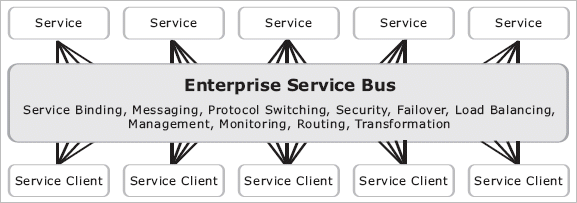
- Messaging, the reliable delivery of information where and when it is needed
- The augmentation of messages with routing information, data mediation and the distribution of business events, commonly referred to as "Service Enrichment"
ESBs deliver business flexibility and service virtualization by enabling a clear separation between applications which run the business. The ESB delivers an infrastructure for connecting the applications and services together, making it possible for business services and solutions to be modified with minimal impact.

WebSphereEnterprise Service Bus
WebSphereMessage Broker
WebSphereDataPowerIntegration Appliance
Customers with an investment in WebSphere technologies like WebSphere Application server, WebSphere Portal or WebSphere BPM can leverage WebSphere ESB with their existing skill set, resulting in lower cost and faster time-to-value.
On the other hand, those whose primary challenge is integrating a wide range of non-standard applications into the standards based infrastructures, as well as those who already have an investment in WebSphere MQ will value the flexibility and depth of capability provided by WebSphere Message Broker.
And for those who value the simplified experience of an appliance form factor with easy administration and configuration, and require security at the message level, network level, and device level, the DataPower Integration Appliance delivers all this out of the box.
Monday, 10 December 2012
Why PureSystems ?
In a previous blog post, I presented my views on one of the key motivation behind IBM's introduction of PureSystems into the marketplace, citing the need for IT to adopt solutions that are optimized to achieve the business agility needed in today's business environments. Most c-level executives anticipate significant change and complexity ahead, with only a handful prepared to handle it. With complexity on the rise, agility becomes a key competitive advantage.
In the past, IT used to be the control point. The lines of business specified their requirements and IT designed and implemented what they needed. The line of business had their own application silos, with IT providing safely through separate ownership and segregation of resources. Increasingly, the line of business teams are making the call, with business owners having greater control. In the cloud space, evidence of this trend can be confirmed by the increasing adoption of Software as a Service applications. Without IT consulation, the business is reaching out to external IT services providers to fulfill their requirements. In one fell swoop, the entire IT organization can be cut out, and to make it worse, the IT organization is left to deal with subsequent integration problems. And clients are demanding more too. The rise of mobile computing puts pressure on IT organizations to deliver support for new types of applications, additional capabilities that enterprise applications never had to deal with before.
This need for agility is transforming the relationship between IT and the business in very profound ways. The true promise of IBM's PureSystems isn’t just about addressing the complexity of IT, it is about redefining the economics of IT. Over half of the business executives believe that cloud computing enables business transformation; leaner, faster, and more agile processes. This is strategic thinking. Organizations that approach cloud in a tactical fashion risk adding complexity and inefficiency due to fragmentation, redundancy and operating silos. PureSystems is designed to accelerate cloud adoption, enabling organizations that embrace cloud strategically, from a business as well as IT perspective, to capture new business value through innovation, flexibility, and speed, with integrity and security, while reducing cost and complexity.
What is Cloud Computing?
Cloud
Computing - NIST* Definition (*National Institute of Standards
and Technology)
Cloud
computing is a model for enabling convenient, on-demand network access to a shared
pool of configurable computing resources (e.g., networks, servers, storage,
applications, and services) that can be rapidly provisioned and released with
minimal management effort or service provider interaction.
but
….. this is a
technology
centric definition. From a Business Point of View....
Cloud
computing is a model for enabling cost effective business
outcomes through the use of shared application and computing services. The value …. if possible …. is better
economics in the execution of business processes.
How is Mobile Computing redefining IT ?
I was recently engaged in a conversation with a practice leader for a mobile community. It was clear during our brief discussion that unlike other technologies, "mobile" meant different things to different people. Whether your focus is on customer-facing or employee-facing applications, or a combination of both, it is clear that mobile is a hot topic in both the enterprise and consumer domains.
 This trend was reflected in the feedback received and documented in IBM's 2011 Global CIO Study. 74% of CIOs identified mobility solutions as an important elementy of their strategy over the next 3-5 years.
This is not a surprise when one considers recent trends. Gartner predicts that by the end of 2013, mobile phones will overtake PCs as the most common Web access device worldwide.
In the last quarter of 2011, over 360,000 iOS devices were activated per day. There are over 500,000 Android device activations per day.
What is driving the exponential growth in mobile? I believe it is a combination of advances in device capabilities, particularly microprocessor and battery technology. These have made the mobile a viable computing platform. And with these advances came applications. The emmergence of Apple's AppStore and Google's Play have resulted in an explosive growth of the mobile platform as a revenue earner for the device manufacturers and service providers.
In April 2013, IBM announced a new category of IT systems, Expert Integrated Systems. With PureSystems, IBM sees an opportunity to radically redefine the economics of IT, incorporating lessons learnt and best practices from Mobile computing.
As with your mobile device, PureSystems ships from the IBM factory fully racked, integrated and configured ready for use. Once the system is powered on, a simple setup wizard enables users to connect the system to their network and deploy pre-loaded applications. There is also an AppStore, the PureSystems Center, where users can search and find applications optimized for PureSystems. Applications certified for PureSystems can be downloaded from the AppStore and deployed on PureSystems. All the knowledge and expertise required to deploy and lifecycle manage the application is defined in Application.
This is not a surprise when one considers recent trends. Gartner predicts that by the end of 2013, mobile phones will overtake PCs as the most common Web access device worldwide.
In the last quarter of 2011, over 360,000 iOS devices were activated per day. There are over 500,000 Android device activations per day.
What is driving the exponential growth in mobile? I believe it is a combination of advances in device capabilities, particularly microprocessor and battery technology. These have made the mobile a viable computing platform. And with these advances came applications. The emmergence of Apple's AppStore and Google's Play have resulted in an explosive growth of the mobile platform as a revenue earner for the device manufacturers and service providers.
In April 2013, IBM announced a new category of IT systems, Expert Integrated Systems. With PureSystems, IBM sees an opportunity to radically redefine the economics of IT, incorporating lessons learnt and best practices from Mobile computing.
As with your mobile device, PureSystems ships from the IBM factory fully racked, integrated and configured ready for use. Once the system is powered on, a simple setup wizard enables users to connect the system to their network and deploy pre-loaded applications. There is also an AppStore, the PureSystems Center, where users can search and find applications optimized for PureSystems. Applications certified for PureSystems can be downloaded from the AppStore and deployed on PureSystems. All the knowledge and expertise required to deploy and lifecycle manage the application is defined in Application.
Sunday, 9 December 2012
The new bread of IT practitioners...
In 2012, a majority of CEOs interviewed during an IBM funded CEO Study identified technology as having the greatest impact on their business. Technology had always featured highly, but this is the first time it was ranked #1.
What does this mean for the IT profession?
You can argue that in future, there will be a need for IT practitioners to focus on enabling business users to consume and control business content for competitive advantage, through a reasoned application of information technology. This requires an IT practitioners to be a
Most c-level executives and technical leaders I have interacted with recently, mostly across Europe, have cited integration and collaboration between IT and Lines of Business as critical success factors for innovative projects. As the CEO study shows, innovation is increasingly delivered through software, applications and technology.
 In April 2012, IBM introduced a new bread of Expert Integrated Systems.
Given that solutions are manifested as architectures, Expert Integrated Systems are integrated in the factory to include systems, applications and process components optimized for specific workloads. PureSystems integrates a broad variety of products, technologies and services, various systems and applications architectures, and diverse hardware and software components into a ready to use system. By taking complexity out of enterprise IT systems, IT practitioners are able to dedicate more of their time to creating strategic business outcomes, aligning business needs with appropriate Solutions and technologies.
This is how I see the professional evolving over time, with IT practitioners collaborating across lines of business and IT to align with strategic business planning, solution design and delivery; leveraging ready to use workload optimized Expert Integrated Systems that accelerate time to value.
What does this mean for the IT profession?
You can argue that in future, there will be a need for IT practitioners to focus on enabling business users to consume and control business content for competitive advantage, through a reasoned application of information technology. This requires an IT practitioners to be a
- Consensus builder
- Results oriented
- Generalist
- A technology expert
- Not just a top level software designer
- Not (just) a programmer
- Not the project manager
- Not a product expert
- Not a lone scientist
Most c-level executives and technical leaders I have interacted with recently, mostly across Europe, have cited integration and collaboration between IT and Lines of Business as critical success factors for innovative projects. As the CEO study shows, innovation is increasingly delivered through software, applications and technology.
Given that solutions are manifested as architectures, Expert Integrated Systems are integrated in the factory to include systems, applications and process components optimized for specific workloads. PureSystems integrates a broad variety of products, technologies and services, various systems and applications architectures, and diverse hardware and software components into a ready to use system. By taking complexity out of enterprise IT systems, IT practitioners are able to dedicate more of their time to creating strategic business outcomes, aligning business needs with appropriate Solutions and technologies.
This is how I see the professional evolving over time, with IT practitioners collaborating across lines of business and IT to align with strategic business planning, solution design and delivery; leveraging ready to use workload optimized Expert Integrated Systems that accelerate time to value.
Subscribe to:
Posts (Atom)